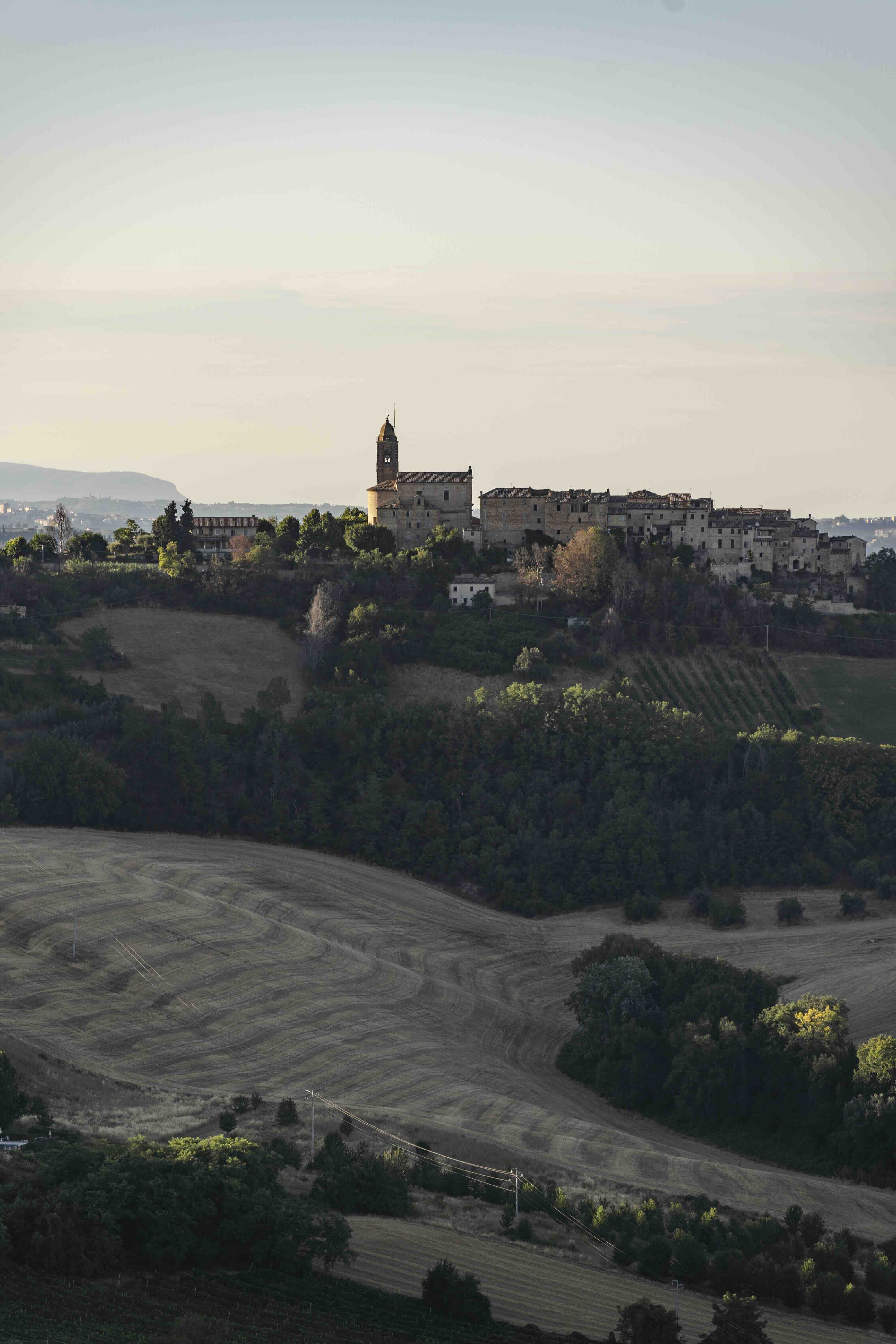




Moregnano is a charming hamlet in the municipality of Petritoli, less than a couple of kilometers from the center. Its origins are very ancient: the first settlements date back to the Picentes. Some archaeological finds indicate that the hill above Moregnano was home to one of the small Picenian villages, with a necropolis where the castle was later founded.
Later, Moregnano came under the control of Roman patricians. The name is thought to stem from a Roman patrician named Muraena, and “Murenianum” was the name of the territory that belonged to him.
The evolution of the area continued during the Farfa period, around the 8th century, at the same time as the construction of the very famous Pieve di Santa Maria Matris Domini in neighboring Ponzano.
The first historical mention regarding the castle dates back to the 11th century, a period when written sources attribute various castles to the bishop of Fermo, Ugone, including, notably, that of “Morangianum”, which was under the control of the city of Fermo.
During the Middle Ages, Moregnano became a fortified castle located on a hill, strategic for controlling the territory. For a brief period, from June 14, 1214 to 1238, the castle was under the rule of the Municipality of Fermo, as part of the Treaty of Polverigi. At that time, the castle had few houses and no church, as the parish church was still at the bottom of the valley, near what is now Fonte Vecchia.
Throughout its history, Moregnano Castle suffered few attacks, but in 1415 it was taken for two years by the Malatesta family during an invasion of the Picenum. Moregnano remained an independent municipality until 1869, when it became a hamlet of Petritoli.
Moregnano was a libero comune (free municipality) until 1869 when, deprived of the municipality, it became a hamlet of Petritoli.
Although Moregnano was one of the oldest castles in the Fermo area, today it retains little of its original structure, as it was profoundly transformed by new buildings in the 18th century. However, the layout of ancient walls is still visible, although it has been adapted to the surrounding houses. The walls feature towers with loopholes and dungeons connecting different parts of the village. The urban layout of the castle designed for defensive purposes is still visible: the village is laid out on a hill in the shape of a “polygonal castle,” with three streets converging toward the central square. Today, you can still walk up a steep ramp to access the castle, which used to have a door and a barbican.
In the heart of the village stands the Church of Santi Vittore e Corona. Built around the mid-18th century, the church features a Neoclassical architectural style and a brick façade. Inside, the church has a single nave topped by a barrel vault with lunettes. On the high altar a mid-18th-century painting depicts Saints Anthony and Francis of Paola by an unknown artist from the Marche region.